
Magento + Hyvä for B2B: 3 sites with 95+ PageSpeed scores despite complex business requirements
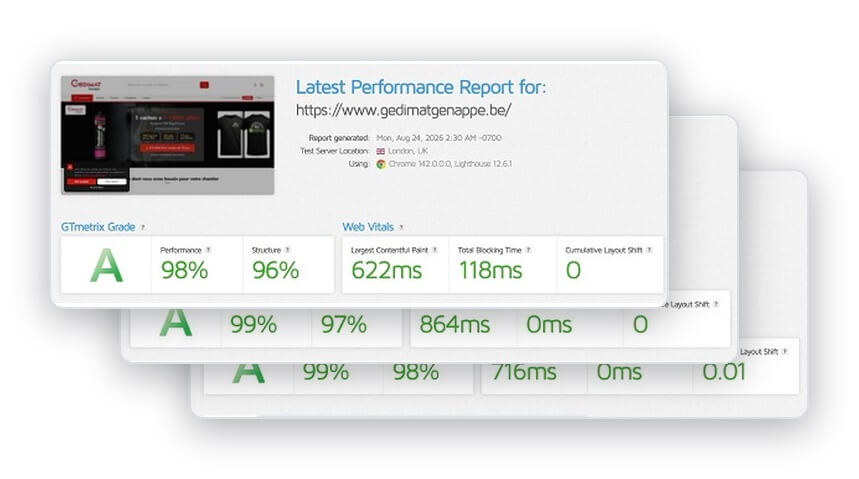
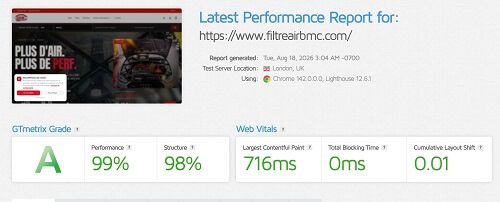
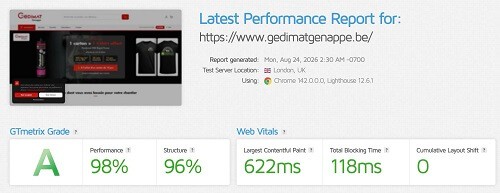
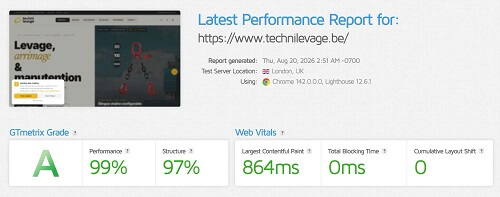
This summer, WiMakeIT delivered three new Magento sites built on Hyvä: Filtre Air BMC, Gedimat Genappe and Technilevage. All three score 95%+ on GTmetrix.
The real challenge
Keeping performance high once the project starts to look like the business that actually uses it.
Three Magento + Hyvä sites, all scoring 95%+: the proof is in the delivery
Three launches · summer 2026
These three projects share neither the same catalogue, nor the same customers, nor the same constraints. That is exactly what makes the result interesting.
Installing Magento and Hyvä is one thing.
Keeping performance high once the business’s real needs are built in is quite another.
Modules, custom development, business rules, media, customer journeys, third-party tools, ERP, commercial features: an e-commerce site naturally grows more complex as it becomes more useful. Performance has to keep up.
A fast B2B site is good. A fast site with the right data is better.
Data · ERP · reliability
In B2B, the frontend is often just the visible part of a much larger system.
ERP, catalogue, pricing, availability, orders, customer accounts, commercial terms: Magento has to fit into an environment that was already running before it arrived.
Question 01
Which data really needs to flow?
Question 02
Which system is the source of truth when information differs?
Question 03
How often does it need to sync?
Question 04
And what happens when a data feed stops responding?
Wrong stock displayed in 200 milliseconds is still wrong stock.
Frontend performance and data reliability therefore have to move forward together.
Commercial data is only valuable if it accurately reflects the reality of the business.
On Gedimat Genappe, the customer journey has to handle prices, variants, availability statuses and different needs for private customers and logged-in trade customers.
ERP–Magento synchronisation: when a few minutes can really matter
ERP · API · synchronisation
Not all data has the same shelf life. A product description can wait. Stock, availability, a price or certain commercial terms, much less so.
Depending on the business, a lag of a few hours may be acceptable. In other B2B environments, data needs to come through within minutes, or almost in real time.
This is no longer just a technical setting. It is a choice that can directly affect the quality of service offered to customers and the day-to-day work of the teams.
Among other things, a synchronisation architecture needs to determine:
01. Which data is critical to sales?
02. Which system is the reference source for it?
03. Which information requires high-frequency updates?
04. What volumes need to be handled?
05. How should updates be prioritised?
06. How can a failed sync be detected?
07. How do you prevent a temporary incident from creating inconsistent data on the customer side?
The goal isn’t simply to move data around.
It’s to move it at the speed the business needs, without sacrificing reliability.
Standard Magento or custom development? The real question lies elsewhere.
Magento architecture · business logic
On this kind of project, it is tempting to frame the debate like this:
Wrong question
Standard or custom?
Better question
What really deserves to be built into the platform?
Two companies selling comparable products can operate in radically different ways.
Pricing, customer permissions, catalogue structure, orders, logistics, configurators, automations, access to certain product ranges or interactions with the ERP: these specifics aren’t necessarily complications to be removed.
Some of them are precisely what gives the business its value.
Magento provides a rich foundation, and its ecosystem already covers many needs. When the standard solution solves the problem properly, there is no reason to reinvent what works.
But when a process, a rule or a service is a genuine business specificity, custom Magento development can become a digital asset in its own right.
When compatibility becomes part of the product.
A single filter reference can fit many vehicles, makes, models and engines. The customer journey therefore links the product to vehicle compatibility logic that goes far beyond a simple product-page attribute.
The quality of an architecture isn’t measured by how much custom development you avoid. It’s measured by how relevant the custom development you choose is.
Magento configurability: hard-code fewer decisions, give teams more control
Team autonomy
There is a third way between standard and rigid custom development: making business logic configurable.
A pricing rule evolves. A commercial condition changes. A product range needs to be displayed differently. A catalogue setting needs adjusting.
Do you really need to open a development ticket every time?
Not necessarily. During scoping, we therefore identify which decisions should stay in the code and which ones teams should be able to manage from the admin panel.
Autonomy
Stay in control of everyday rules
Responsiveness
Act on commercial decisions faster
Dependency
Avoid a development job for every tweak
Scalability
Let the platform evolve with the business
A good platform doesn’t just do what it’s asked to do today. It also leaves enough room to decide tomorrow.
A B2B product isn’t always just “a product”
B2B catalogue
A technical item can carry far more than a name, a photo and a price.
Capacity, dimensions, length, power supply, application, options or variants can determine what the customer chooses and how they need to be guided.
The right journey isn’t always just “Add to cart”.
In an industrial lifting catalogue, capacity, technical specifications and configuration directly influence the choice. Some items therefore naturally call for a richer enquiry or quote journey than a standard product page.
A catalogue shouldn’t just store products. It should help customers make the right decision.
Hyvä for Magento: performance isn’t a bonus, it’s the starting point
Magento frontend
Why Hyvä in this equation? Because it gives Magento a frontend designed around reduced complexity, fewer dependencies and improved performance.
For a B2B user, the benefits are very tangible.
Browse
A large catalogue has to stay fast
Even when the customer is viewing a large number of items.
Find
Searching for a part number has to stay smooth
The coffee break can wait.
Order
Repeat customers need speed
Especially when they use the site as an everyday work tool.
Hyvä provides the potential.
The agency builds the result.
As the project progresses, components, media, modules, third-party scripts, business features and custom code are added. Every choice can either preserve Hyvä’s initial advantage… or gradually erode it.
That is exactly why frontend expertise has to remain tied to broader Magento expertise.
At WiMakeIT, Hyvä isn’t treated as a graphic layer added at the end of the project. Performance, user experience, custom development, integrations and business needs have to be weighed up together.
Filtre Air BMC
Vehicle compatibility built into the catalogue journey.
Gedimat Genappe
Building materials catalogue, B2B & B2C, pricing, variants and services.
Technilevage
Technical industrial catalogue and quote-driven journeys.
Three contexts that don’t ask Hyvä to do less. They ask the agency to know how to do more without sacrificing performance.
B2B Magento SEO: 10,000 products are of little use if nobody can find number 9,847
B2B Magento SEO
A large catalogue is a commercial asset.
On one condition: it has to be discoverable.
Categories, subcategories, filters, attributes, variants, parameters and navigation combinations can quickly create a very large architecture.
Having 10,000 products online is not yet a visibility strategy.
Search engines need to be able to distinguish the genuinely useful pages, the strategic product families and the combinations that match real search intent.
For a B2B business, the potential often lies well beyond the company name or a few top-level categories.
A buyer may search for a product family, a dimension, a material, an application, a technical feature, a use case or a very specific combination of criteria.
Three catalogues · three search logics
Filtre Air BMC
The need may start with a make, a model and an engine.
Gedimat Genappe
The entry point may be a type of building project, then a product family and subfamily.
Technilevage
The search may focus on a technical family, a type of equipment or a specific capacity.
Same technology. Three radically different search intents.
That’s why the SEO structure has to be designed as part of the catalogue architecture from the start: categories, navigation depth, internal linking, strategic pages, indexability, filters, URLs, content and structured data.
SEO for a large Magento site isn’t about adding keywords after development.
It’s about building an architecture in which the catalogue can become a coherent network of commercial entry points.
Magento specifications: the most expensive decisions are often made before development starts
Magento project scoping
A complex project can be perfectly developed… on the basis of the wrong initial decisions.
It’s usually cleaner.
But it’s still the wrong project.
Scoping is there precisely to prevent that.
Before talking about modules or timelines, you need to understand:
→ how the business sells today;
→ what it wants to improve tomorrow;
→ how its catalogue is structured;
→ where its data lives;
→ which synchronisations need to be fast;
→ which rules are genuine business specificities;
→ what the teams need to be able to configure;
→ how the site will need to be found;
→ what volumes and growth the architecture will need to absorb.
A useful specification is therefore not a list of features with boxes to tick.
It’s the translation of business objectives into functional and technical decisions.
And that’s often where four proposals all saying “Magento + Hyvä” finally start to look different.
Magento + Hyvä: the technology is the same. What you do with it, much less so.
What really sets a project apart
Magento. Hyvä. ERP. API. SEO. Custom development. On paper, several agencies can list exactly the same words.
The difference rarely lies in the list of technologies. It lies in the trade-offs.
Which data needs to be near-instant?
Which rule really deserves custom development?
Which setting should stay in the teams’ hands?
Which part of the catalogue deserves to become an SEO entry point?
Which feature risks degrading performance?
How will all of this still work once the business has evolved?
So what are three GTmetrix scores of 95%+ really worth?
A GTmetrix score is a technical measurement taken under specific conditions. It doesn’t measure the quality of a catalogue, the soundness of an ERP architecture or a site’s future revenue.
And thankfully so.
Otherwise, the job would be a lot simpler.
What interests us more here is the repeatability of the result.
What this result really means
Three companies, three sectors, three catalogues with nothing in common: vehicle compatibility, building materials, industrial lifting. Different business constraints, different customers, different search logics.
And yet the same level of performance after going live. That’s not a lucky break on a one-off project. It’s a method that delivers the same result in contexts that look nothing alike.
For decision-makers looking for the right technical partner to build a solid project for the long term, that is exactly what matters. Almost anyone can show a good launch score one day. The real question lies elsewhere:
Does performance hold up over time?
Once modules, media, ERP integrations and custom code have been added, is the site still as fast as on day one?
Does it translate into results?
A fast site supports conversion, search rankings and the teams’ daily work — not just a number in a report.
Is it reproducible?
Does the result depend on a lucky project, or on a way of working that carries over from one project to the next?
A large B2B e-commerce site inevitably becomes complex. It doesn’t have to become complicated.
Magento + Hyvä project
Does your project need to handle much more than a catalogue?
An ERP to connect, fast synchronisations, a large catalogue, specific commercial rules, custom development, configurability needs or SEO challenges: these are exactly the topics that need scoping before choosing the technical answers.
Catalogue · ERP & API · synchronisation · business rules · custom development · Hyvä · performance · SEO
Discuss your Magento project →Technical and business discussion
Published 17 Aug 2026
A question about this article?
30 minutes, no strings attached, with a senior technical contact.
Also worth reading
Other articles

Migrate from Magento1 to Magento2
Magento1 was released in 2009 and was developed with the technologies and best practices of the time. The support of ...
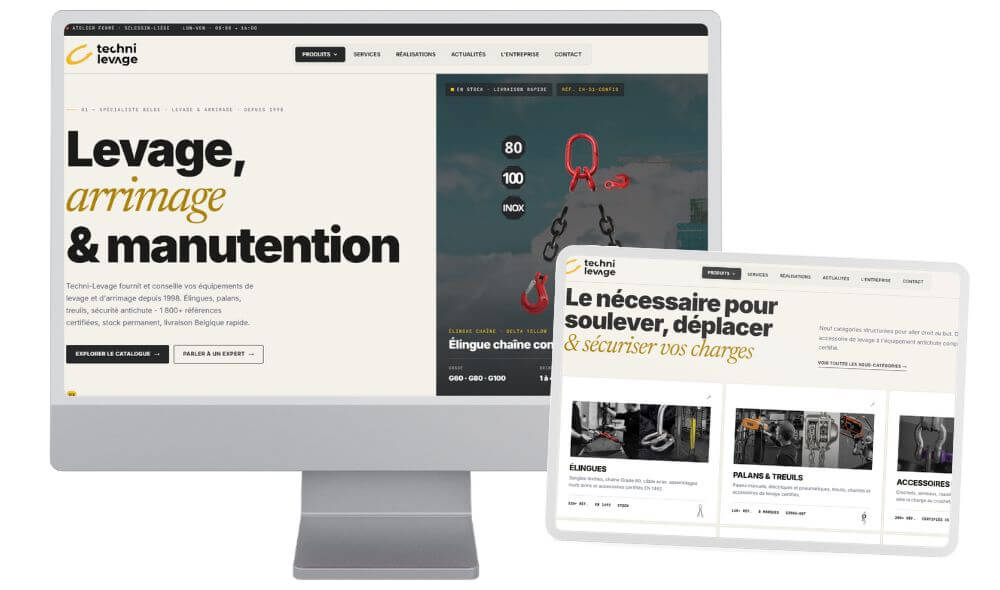
Technilevage – Online Quote Requests for the B2B Sector
MageOS site with Hyvä theme – Techni-Levage: your lifting and lashing equipment supplier and advisor since 1998.

Hyvä Theme & Hyvä Commerce
Shift up a gear with Hyvä